DNS vs B.Sc. Nautical Science – Which Is Better for Merchant Navy?
DNS or B.Sc. Nautical Science? Compare course duration, cost, career growth, salary, and future scope with Marine Edge’s expert guidance
DNS vs B.Sc. Nautical Science: Which Is the Better Path to the Merchant Navy?
Marine Edge Career Guide
DNS and B.Sc. Nautical Science is one of the two most popular courses to join the Merchant Navy after Class 12.
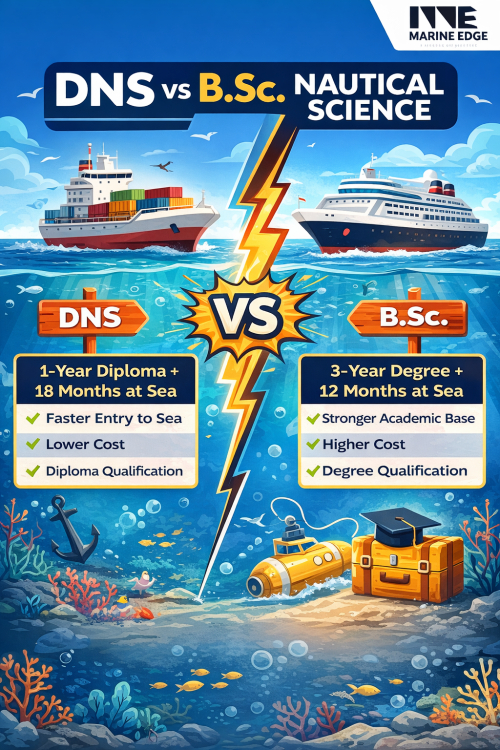
DNS is a 1-year fast-track diploma that helps you go to sea earlier, while B.Sc. Nautical Science is a 3-year degree course that offers stronger academic depth and long-term flexibility.
Both routes ultimately lead to the same officer ranks, including Third Officer, Chief Officer, and Captain. The real difference lies in time, cost, academic recognition, and future career options.
This Marine Edge guide breaks down DNS vs B.Sc. Nautical Science point by point so you can choose the right path based on facts, not confusion.
DNS vs B.Sc. Nautical Science: Quick Answer
DNS is a faster, more practical route to go to sea early, while B.Sc. Nautical Science offers deeper academic grounding and better long-term flexibility.
Both courses ultimately lead to the same officer ranks in the Merchant Navy.
| Key Points | DNS (Diploma in Nautical Science) | B.Sc. in Nautical Science |
|---|---|---|
| Course Duration | 1 year in college | 3 years in college |
| Fees | Generally lower compared to B.Sc. | Higher due to a 3-year degree program |
| Sponsorship | Compulsory before joining the course | Not compulsory at the time of admission |
| Type of Degree | Diploma initially, B.Sc. degree awarded after the 2nd Mate exam | Direct B.Sc. degree from the start |
| College Life | Short college life (only 1 year) | Full college life (3 years) |
| Cadetship Duration | 18 months onboard as Deck Cadet | 12 months onboard as Deck Cadet |
| Average Time to Become 3rd Officer | 4 – 4.5 years (varies by company waiting period + 2nd Mate exam timeline) | 5 – 6 years (varies by company waiting period + 2nd Mate exam timeline) |
Marine Edge Insight:
DNS helps you reach the sea faster, while B.Sc. Nautical Science offers stronger academic recognition and long-term flexibility. The right choice depends on your timeline, sponsorship status, and career vision.
1. Course Duration
DNS (Diploma in Nautical Science)
-
1 year pre-sea training
-
Followed by 18 months of sea service
-
Eligible to appear for the Third Officer exams earlier
B.Sc. in Nautical Science
-
3-year academic degree
-
Followed by 12 months of sea service
-
Eligible for Third Officer exams after graduation
Key Difference:
DNS gets you to sea faster. B.Sc. takes longer but builds a stronger academic base.
2. Course Structure
DNS
DNS is practical and industry-oriented.
The focus is on:
-
Shipboard life
-
Seamanship
-
Bridge watchkeeping
-
Real-world ship operations
After classroom training, cadets quickly move on board for hands on experience.
B.Sc. Nautical Science
B.Sc. offers a university-style education with:
-
Navigation and ship stability
-
Meteorology
-
Maritime law
-
Extensive theory, labs, and simulations
Key Difference:
DNS is practical-first. B.Sc. is concept-first.
3. Eligibility Criteria
DNS Eligibility
-
10+2 with Physics, Chemistry, Mathematics (PCM)
-
Minimum 60% in PCM
-
50% in English
-
Must clear IMU-CET
-
Must meet DGS medical standards
B.Sc. Nautical Science Eligibility
-
Same academic and medical requirements
-
IMU-CET mandatory
Key Difference:
There is no real eligibility advantage of one over the other.
4. Job Opportunities After The Course
DNS
-
Start sailing earlier as a Deck Cadet / Trainee Officer
-
Reach officer ranks slightly faster if everything goes smoothly
B.Sc. Nautical Science
-
Same starting roles after sea service
- Reach officer ranks slightly later as compared to DNS (Depends on the shipping company you are working with)
Key Difference:
Initial jobs are the same. Long term promotions are faster in DNS.
5. Cost of Education
DNS
-
Approx ₹5-8 lakhs for 1 year
-
Additional costs for sea training and exams
B.Sc. Nautical Science
-
Approx ₹10–15 lakhs for full 3 years
Key Difference:
DNS is cheaper upfront. B.Sc. costs more but offers academic value.
6. Academic Recognition
DNS
-
Diploma-level qualification
-
Fully valid for sailing careers
B.Sc. Nautical Science
-
Bachelor’s degree
-
Recognised internationally
-
Useful for:
-
Higher studies (MBA, MSc)
-
Shore jobs
-
Management roles later
-
Key Difference:
B.Sc. provides broader academic recognition.
7. Future Career Growth
DNS
-
Growth depends heavily on:
-
Sea performance
-
Competency exams
-
Company opportunities
-
B.Sc. Nautical Science
-
Same sea growth path
-
Easier transition to:
-
Shore-based roles
-
Maritime management
-
Teaching and administration
-
Key Difference:
B.Sc. offers more career flexibility beyond ships.
Marine Edge Recommendation: Which One Should You Choose?
At Marine Edge, we don’t believe in one “best” course for everyone.
Think of this as a decision filter, not a comparison. Answer honestly and follow the path.
Step 1: How fast do you want to go to sea?
-
I want to start sailing as early as possible → Go to DNS
-
I’m okay spending more time studying first → Go to B.Sc. Nautical Science
Step 2: Do you already have or can you realistically secure sponsorship?
-
Yes, I have sponsorship / strong leads → DNS is a strong option
-
No, not yet / unsure → B.Sc. Nautical Science is safer
Why this matters:
DNS usually requires sponsorship before joining, while B.Sc. does not.
Step 3: What matters more to you right now?
-
Quick entry + practical ship exposure → DNS
-
Degree + academic recognition → B.Sc. Nautical Science
Step 4: Are you thinking long-term beyond sailing?
-
No, I want to sail till Captain → DNS or B.Sc. (both work)
-
Yes, I may want shore jobs / MBA / management later → B.Sc. Nautical Science
A degree gives flexibility if plans change later.
Step 5: Budget reality check
-
Limited budget, want lower upfront cost → DNS
-
Comfortable investing more for a degree → B.Sc. Nautical Science
Final Decision Summary
Choose DNS if:
-
You want the fastest route to sea
-
You are confident about sponsorship
-
You prefer practical learning
-
You want to start earning earlier
Choose B.Sc. Nautical Science if:
-
You want a recognized degree
-
You don’t have sponsorship yet
-
You value academic depth
-
You want long-term flexibility (shore roles, higher studies)
Marine Edge Reality Check (Important)
At Marine Edge, we’ve seen this repeatedly:
Students don’t fail because they chose DNS or B.Sc.
They fail because they chose without understanding sponsorship, timelines, and medical eligibility.
Both paths can take you to the Captain’s chair.
The right choice depends on you, not trends or social media opinions.
Frequently Asked Questions (FAQ) – SEO Boost
Is DNS better than B.Sc. Nautical Science?
DNS is better if you want a faster entry to sea. B.Sc. is better if you want academic depth and long-term flexibility.
Can DNS cadets become Captains?
Yes. DNS cadets can become Captains after completing sea service and passing competency exams, just like B.Sc. graduates.
Does salary differ between DNS and B.Sc. officers?
No. Salary depends on rank and company, not whether you chose DNS or B.Sc.
Is B.Sc. Nautical Science safer for the future?
Yes, because it provides a recognized degree useful for shore jobs and higher studies.
Is Sponsorship more important for DNS or B.Sc.?
Sponsorship is important for both, but especially mandatory for DNS.
Conclusion
DNS and B.Sc. Nautical Science are not rivals — they are two different strategies.
One prioritizes speed. The other prioritizes flexibility.
The right choice depends on your timeline, finances, academic interests, and long-term vision.
At Marine Edge, we help aspirants choose the path that fits their career, not someone else’s success story.
What's Your Reaction?