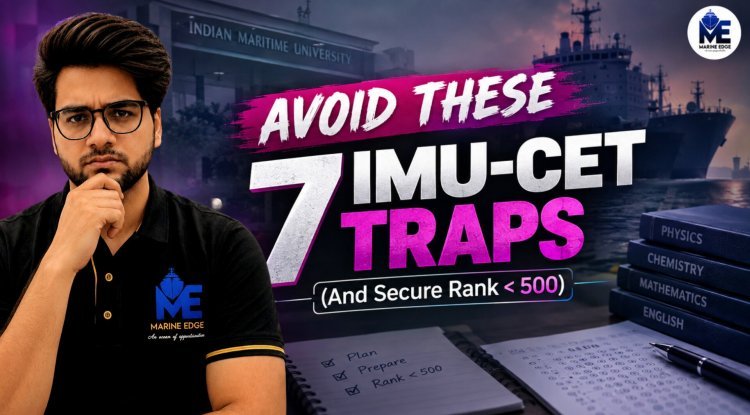
IMU-CET Preparation Mistakes: Errors That Could Be Ruining Your Study Plan
Preparing for IMU-CET 2026? Learn 15 common preparation mistakes that can waste your time and discover practical ways to improve your study plan, mock tests and revision.
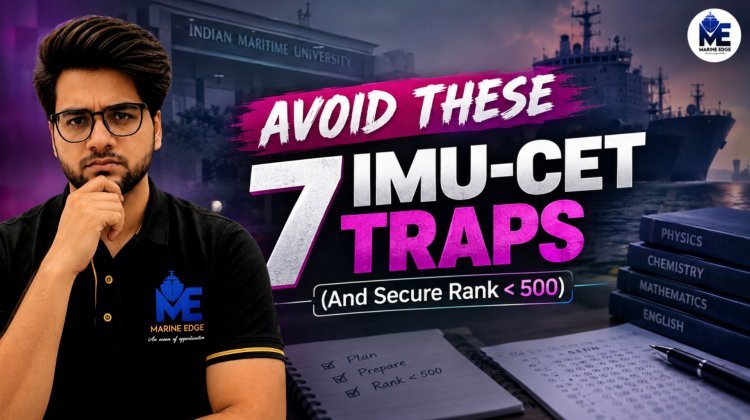
Top Mistakes to Avoid in IMU-CET Preparation and How to Fix Them
Preparing for IMU-CET? Learn the most common mistakes students make with syllabus planning, study materials, mock tests, time management, revision, online preparation, and exam strategy—and discover practical ways to fix them.
Preparing for a maritime entrance examination is not simply about studying for long hours.
A student can spend months preparing and still struggle if the preparation process is poorly organised.
Some students begin without understanding the syllabus.
Others collect too many books and online resources.
Some avoid mock tests because they are afraid of low scores.
Others take hundreds of tests but never analyse their mistakes.
Then there are students who focus almost entirely on Mathematics and Physics while neglecting other applicable sections.
The result can be a preparation process that feels busy but isn't necessarily productive.
So what should an IMU-CET aspirant do?
The answer begins by identifying the mistakes that can slow down preparation.
This Marine Edge guide explains the top mistakes to avoid in IMU-CET preparation and practical ways to fix them.
IMU-CET Preparation Mistakes at a Glance
| Common Mistake | Why It Can Be a Problem | How to Fix It |
|---|---|---|
| No Study Plan | Preparation becomes inconsistent | Create weekly targets |
| Ignoring the Syllabus | Important topics may be missed | Build a topic checklist |
| Too Many Resources | Creates confusion | Use limited reliable resources |
| Only Studying Theory | Weak application ability | Solve questions regularly |
| Avoiding Weak Topics | Creates knowledge gaps | Give extra practice to weak areas |
| Not Taking Mock Tests | Poor exam familiarity | Take regular timed tests |
| Ignoring Mistakes | Same errors repeat | Maintain an error log |
| Poor Time Management | Questions remain incomplete | Practise with a timer |
| Last-Minute Revision | Increases pressure | Revise throughout preparation |
| Comparing With Others | Distracts from personal progress | Track your own improvement |
| Ignoring English/Aptitude | Preparation becomes unbalanced | Practise all applicable sections |
| Studying Without Breaks | Concentration can decline | Use focused study sessions |
Let's understand each mistake in detail.
Mistake 1: Starting Preparation Without a Plan
One of the most common mistakes is starting preparation immediately without deciding what needs to be completed.
A student may study:
Maths today → Physics tomorrow → random Chemistry chapter → YouTube lecture → mock test
There is no clear progression.
How to Fix It
Create a weekly study plan.
For example:
Monday: Mathematics + Physics
Tuesday: Chemistry + English
Wednesday: Mathematics + Aptitude
Thursday: Physics + Chemistry
Friday: Weak topics
Saturday: Mock test
Sunday: Revision + error analysis
The schedule can be customised around your school and coaching timetable.
The important thing is having a plan.
Mistake 2: Ignoring the Applicable Syllabus
Some students start solving questions without checking what they actually need to prepare.
This can result in:
- Missing important topics
- Spending excessive time on less relevant material
- Poor revision planning
- Unnecessary stress
How to Fix It
Create a complete syllabus checklist.
Mark every topic as:
Not Started
Learning
Practising
Completed
Needs Revision
Always verify the latest applicable syllabus and examination information from the official source for your admission cycle.
Mistake 3: Using Too Many Books and Online Resources
The internet has made study material incredibly accessible.
But this can create a new problem.
Resource overload.
One teacher explains a chapter one way.
Another teacher explains it differently.
Then you find another PDF.
Then another question bank.
Soon, you have five different resources but haven't completed any of them properly.
How to Fix It
Use the:
1 + 1 + 1 Rule
For each subject, aim to have:
1 primary learning source
1 question-practice source
1 mock-test source
Additional resources can be used when you genuinely need another explanation.
Mistake 4: Only Watching Lectures
Watching a three-hour lecture can feel like serious studying.
But watching is not the same as learning.
You need to apply the concepts.
How to Fix It
After every major concept, solve questions.
Use:
Lecture → Notes → Basic Questions → Advanced Practice → Test
If you cannot solve the questions after watching the lecture, go back and identify exactly where the understanding breaks down.
Mistake 5: Avoiding Difficult Topics
Students naturally prefer topics they already understand.
It feels good to score 90% in an easy chapter.
But repeatedly practising your strongest subject doesn't necessarily fix your weaknesses.
How to Fix It
Identify your weakest topics.
For example:
| Topic | Test Score | Action |
|---|---|---|
| Algebra | 86% | Maintain |
| Trigonometry | 62% | More practice |
| Mechanics | 58% | Relearn |
| Electricity | 74% | Revise |
Your preparation should give additional attention to areas where performance is weak.
Mistake 6: Preparing Only for Mathematics and Physics
Because PCM subjects are important for many maritime admission pathways, students may spend almost all their time on them.
But depending on the applicable examination pattern, other areas can also matter.
These may include:
- English
- Aptitude
- General awareness
- Reasoning
How to Fix It
Give these areas regular attention.
Even 20–30 minutes of consistent daily practice can be useful for language and aptitude skills.
Always follow the subjects applicable to your particular examination cycle.
Mistake 7: Not Taking Mock Tests
Some students think:
"I'll start mock tests after I finish the entire syllabus."
The problem is that you may discover your time-management issues too late.
How to Fix It
Introduce tests gradually.
Topic test
↓
Sectional test
↓
Mixed test
↓
Full-length mock
This lets you become comfortable with timed examination conditions.
Mistake 8: Taking Mock Tests but Not Analysing Them
This is one of the biggest missed opportunities.
Imagine you score 65%.
You take another test.
You score 68%.
But you haven't identified why you are losing marks.
Your preparation becomes repetitive.
How to Fix It
After every mock, ask:
Which questions did I get wrong?
Why did I get them wrong?
Which questions took too long?
Which concepts need revision?
How many mistakes were avoidable?
This turns a mock test into a learning tool.
Mistake 9: Not Maintaining an Error Log
Students often repeat the same mistakes because they don't record them.
A simple error log can solve this problem.
| Question Topic | Mistake | Reason | Correction |
|---|---|---|---|
| Trigonometry | Wrong identity | Formula confusion | Revise formulas |
| Physics | Unit error | Careless calculation | Check units |
| Chemistry | Concept mistake | Weak theory | Relearn chapter |
| English | Grammar error | Rule not remembered | Practise examples |
Review the log every week.
Your mistakes can become a roadmap for revision.
Mistake 10: Poor Time Management
Some students know the answer but spend too much time reaching it.
Others become stuck on one difficult question and lose time that could have been used on easier questions.
How to Fix It
Practise with a timer.
Learn to distinguish between:
Easy questions
Moderate questions
Time-consuming questions
Questions to revisit
The goal is not simply to solve quickly.
The goal is to use the available time intelligently while maintaining accuracy.
Mistake 11: Last-Minute Revision
Trying to revise the entire syllabus in the final few days can create unnecessary pressure.
You may remember formulas temporarily but struggle to recall them later.
How to Fix It
Use regular revision.
A simple cycle is:
Learn today
↓
Revise after a few days
↓
Practise next week
↓
Test later
↓
Revisit before the examination
This spreads revision across your preparation period.
Mistake 12: Ignoring Basic Concepts
Some students immediately start solving difficult questions because they believe difficult questions represent better preparation.
But advanced questions become easier when the fundamentals are strong.
How to Fix It
Build your preparation in levels:
Level 1
Understand the concept.
Level 2
Solve basic questions.
Level 3
Solve moderate questions.
Level 4
Attempt timed mixed questions.
Level 5
Apply the concept in mock-test conditions.
Don't skip Level 1 simply because Level 4 looks more impressive.
Mistake 13: Constantly Comparing Your Scores
Your friend scores 85%.
You score 70%.
Another student scores 92%.
This can make you feel like you are falling behind.
But one score doesn't tell the complete story.
How to Fix It
Track your own progression.
For example:
Mock 1: 61%
Mock 2: 67%
Mock 3: 73%
Mock 4: 78%
The important information is what is changing in your own preparation.
Also examine why your score changed.
Mistake 14: Studying for Very Long Hours Without Structure
Studying for ten hours doesn't automatically mean ten productive hours.
Long, unstructured study sessions can reduce concentration.
How to Fix It
Use focused sessions.
For example:
50 minutes study
10 minutes break
Repeat as appropriate.
During breaks, step away from the study material.
Quality and consistency matter.
Mistake 15: Ignoring Sleep and Routine
Preparation is not only about books and tests.
A highly irregular routine can make it harder to maintain consistent study.
How to Fix It
Try to maintain:
- Regular sleep
- Consistent study timings
- Planned breaks
- Proper meals
- Limited unnecessary screen time
Your preparation should be sustainable.
Mistake 16: Believing That Qualifying Is the Entire Goal
Students sometimes focus only on meeting a minimum qualifying requirement.
But admission opportunities can depend on factors such as rank, course availability, institute, counselling and applicable admission rules.
How to Fix It
Prepare to maximise your performance rather than preparing only to cross a minimum threshold.
At the same time, avoid assuming that a particular score guarantees admission.
Always check the applicable official admission process for your year.
Mistake 17: Ignoring Medical Eligibility
This is particularly important for students planning a Merchant Navy career.
A student may spend months preparing academically without first understanding whether they satisfy applicable maritime medical standards.
How to Fix It
Investigate medical eligibility early.
Depending on the career pathway, areas such as:
- Eyesight
- Colour vision
- Hearing
- General physical fitness
can be relevant.
Students should use the current requirements applicable to their intended course and obtain advice from an appropriately authorised maritime medical professional where required.
Mistake 18: Treating Sponsorship as Automatic
For students considering DNS, sponsorship can be a particularly important part of planning.
However:
IMU-CET qualification does not automatically mean company sponsorship.
Company sponsorship and admission are separate considerations where applicable.
How to Fix It
Research the current sponsorship process for the companies and programs you are considering.
Prepare for possible:
- Written tests
- Aptitude tests
- English assessments
- Interviews
- Psychometric assessments
- Medical requirements
Selection procedures can change, so students should verify current company requirements.
A Better IMU-CET Preparation System
Instead of simply studying harder, create a cycle:
Step 1 — Plan
Understand the syllabus and create weekly targets.
Step 2 — Learn
Build strong conceptual foundations.
Step 3 — Practise
Solve topic-wise questions.
Step 4 — Test
Take timed tests.
Step 5 — Analyse
Identify mistakes and weak areas.
Step 6 — Revise
Revisit difficult concepts.
Step 7 — Repeat
Continue the cycle until the examination.
This creates continuous improvement.
A Sample Weekly Preparation Framework
| Day | Main Focus | Additional Work |
|---|---|---|
| Monday | Mathematics | English |
| Tuesday | Physics | Aptitude |
| Wednesday | Chemistry | Revision |
| Thursday | Mathematics | English |
| Friday | Physics | Weak topics |
| Saturday | Full/sectional test | Test analysis |
| Sunday | Revision | Error-log review |
This is only a sample.
Students should modify it according to their individual preparation needs.
How Marine Edge Helps Students Avoid These Mistakes
Structured IMU-CET Classes
Follow a planned preparation structure instead of randomly studying chapters.
Topic-Wise Practice
Build confidence gradually through targeted questions.
Mock Tests
Practise examination-style questions under timed conditions.
Performance Analysis
Understand where marks are being lost.
Doubt Solving
Resolve difficult concepts before they become repeated mistakes.
Revision Strategy
Use planned revision instead of relying on last-minute preparation.
Merchant Navy Guidance
Understand the larger career pathway, including course selection, admission and sponsorship considerations.
Frequently Asked Questions
What is the biggest mistake in IMU-CET preparation?
There isn't one mistake that affects every student. Common problems include lack of planning, insufficient practice, poor revision and failing to analyse mock-test mistakes.
When should I start mock tests?
Begin with topic-wise tests once you have studied individual topics. Gradually move toward sectional and full-length tests.
Should I solve questions every day?
Regular question practice is useful because entrance examinations require application of concepts, not only theoretical knowledge.
Is studying 10 hours a day necessary?
There is no universal number of hours. A consistent, focused schedule is generally more useful than simply maximising study time.
Should I join online coaching?
Online coaching can be useful if you benefit from structured classes, regular tests and guidance. The important factor is whether the learning system fits your needs.
Should I use multiple books?
You can use supplementary books when required, but using too many resources can create confusion. Focus on completing a manageable set of reliable materials.
Is IMU-CET the only thing I should prepare for?
Students should consider all applicable admission and selection requirements for their intended course, including company sponsorship where relevant.
Should I check medical eligibility before admission?
Yes. Students planning a sea-going Merchant Navy career should understand the applicable medical standards early in the process.
Final Insight
IMU-CET preparation isn't a competition to see who can collect the most books, watch the most lectures or study the longest hours.
It is a process of continuous improvement.
Don't just ask:
"How many hours did I study today?"
Also ask:
"What did I learn?"
"What did I practise?"
"What mistakes did I make?"
"What will I improve tomorrow?"
The most useful preparation cycle is:
Plan → Learn → Practise → Test → Analyse → Revise → Improve
Avoiding common mistakes doesn't guarantee a particular examination result, but it can make your preparation more organised and help you use your study time more effectively.
Remember that the ultimate objective is bigger than an entrance examination.
You are preparing for a professional maritime career where discipline, accuracy, responsibility, communication and continuous learning matter.
Start early.
Prepare consistently.
Analyse your mistakes.
And keep improving.
Stay Updated with Marine Edge
For IMU-CET preparation, Merchant Navy admission updates, DNS sponsorship information and maritime career guidance, follow Marine Edge.
Join Marine Edge Telegram for regular updates:
https://t.me/marineedge
Join Marine Edge WhatsApp Group:
https://chat.whatsapp.com/Kosy0usp3q77tUTkk6JBj4?mode=gi_t
Follow Marine Edge WhatsApp Channel:
https://whatsapp.com/channel/0029Vb66BOeLNSZuz7Z1Fb0R
Don't just prepare for the exam. Prepare for the journey ahead.
Marine Edge — Prepare Smart. Sail Far.
What's Your Reaction?