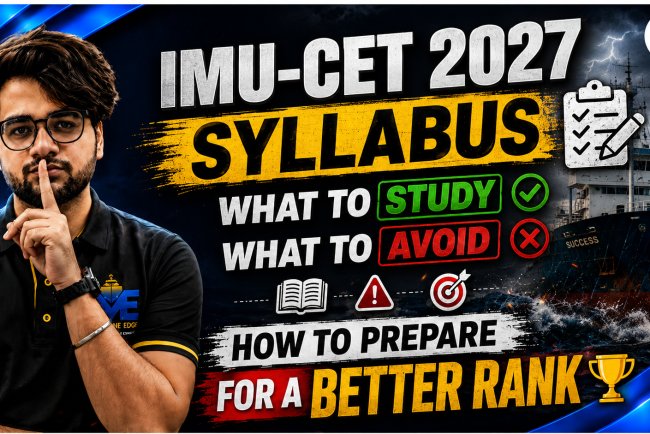
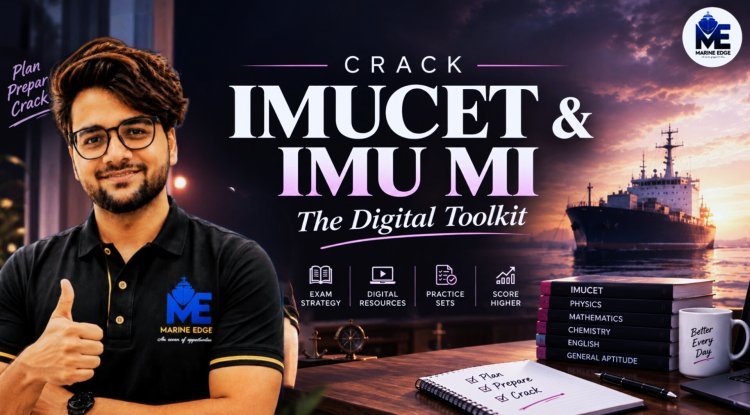
IMU-CET Preparation: 10 Online Tools Most Students Ignore
Preparing for IMU-CET 2026? Discover 10 practical online tools for classes, mock tests, revision, question practice, time management and smarter preparation.
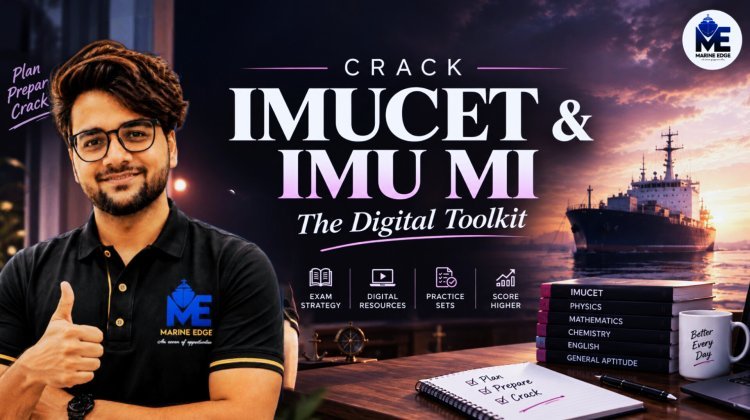
Navigating IMU-CET and IMU MI Preparation with Practical Online Tools
Confused about how to prepare for IMU-CET and IMU-related maritime entrance requirements? Learn how online classes, mock tests, question banks, AI tools, digital notes, study planners, and practice platforms can help you build a structured preparation strategy for a Merchant Navy career.
Every year, thousands of students with dreams of joining the Merchant Navy begin preparing for maritime entrance examinations.
For many Class 12 students, the preparation journey can feel confusing.
There are textbooks, coaching classes, online lectures, mock tests, question banks, PDFs, educational apps and countless videos available online.
The problem is not a lack of study material.
The real challenge is knowing:
What should I study?
Which resources should I use?
How should I practise?
How do I know whether my preparation is improving?
How can I use online tools without wasting time?
A successful preparation strategy does not require students to use every available app or website.
Instead, the objective should be to build a simple system:
Learn → Practise → Test → Analyse → Revise
This Marine Edge guide explains how students preparing for IMU-CET and related maritime admission processes can use practical online tools to make their preparation more organised and measurable.
What is IMU-CET Preparation?
IMU-CET preparation generally involves building strong fundamentals in the subjects and aptitude areas applicable to the student's admission cycle.
Depending on the applicable examination and program, students may need to prepare areas such as:
- Mathematics
- Physics
- Chemistry
- English
- General Aptitude
- General Knowledge or related areas
However, students should always verify the latest official examination pattern, syllabus and admission requirements applicable to their intended course.
Preparation should not begin with random question solving.
The first step should be understanding the examination.
Why Online Tools Can Help IMU-CET Aspirants
Traditional books remain important, but online tools can add flexibility to preparation.
A student can use digital resources to:
- Watch concept explanations
- Practise topic-wise questions
- Take timed tests
- Track scores
- Revise formulas
- Maintain digital notes
- Identify weak topics
- Review mistakes
- Create study schedules
- Practise from different locations
The biggest advantage is not simply convenience.
It is measurability.
Instead of saying:
"I studied mathematics for three hours."
You can track:
"I completed trigonometry, solved 50 questions and scored 78% in the topic test."
That difference can make preparation much more structured.
Online Tools for IMU-CET Preparation
| Tool / Resource | Main Purpose | How Students Can Use It |
|---|---|---|
| Online Classes | Concept building | Learn difficult topics |
| Video Lectures | Visual explanation | Understand concepts differently |
| Digital Notes | Revision | Store formulas and important concepts |
| Question Banks | Practice | Solve topic-wise questions |
| Mock Tests | Exam practice | Improve speed and accuracy |
| Timers | Time management | Practise under pressure |
| Spreadsheets | Progress tracking | Monitor preparation |
| Flashcards | Memory revision | Revise formulas and vocabulary |
| AI Learning Tools | Additional explanation | Clarify difficult concepts |
| Online Doubt Sessions | Problem solving | Get help with difficult questions |
The objective is not to use all of them.
The objective is to select the tools that actually improve your preparation.
Step 1: Understand the IMU-CET Syllabus
Before starting preparation, understand what you are preparing for.
Create a subject-wise checklist.
For example:
Mathematics
- Algebra
- Trigonometry
- Coordinate Geometry
- Calculus
- Probability
- Mensuration
Physics
- Mechanics
- Heat
- Thermodynamics
- Waves
- Electricity
- Magnetism
- Optics
Chemistry
- Physical Chemistry
- Organic Chemistry
- Inorganic Chemistry
English
- Grammar
- Vocabulary
- Reading comprehension
- Sentence correction
Aptitude
- Logical reasoning
- Numerical reasoning
- Basic problem solving
The exact syllabus should always be checked against the applicable official examination information.
Step 2: Use Online Classes for Concept Building
Online classes can be especially useful when students find a chapter difficult to understand from a textbook.
For example, suppose you are struggling with:
Trigonometric equations
You can first study the topic through your primary learning material.
If the concept remains unclear, an online lecture can provide another explanation.
The important rule is:
Don't keep switching between ten different teachers.
Choose a reliable learning source and follow it consistently.
Step 3: Create Digital Revision Notes
One of the most practical uses of technology is digital note-taking.
Create separate sections for:
- Important formulas
- Difficult concepts
- Frequently repeated mistakes
- Short methods
- Vocabulary
- Important definitions
- Questions you couldn't solve
For example:
Mathematics Formula Bank
Topic: Trigonometry
Formula: Important identity
Where I make mistakes: Sign conventions
Revision date: Sunday
Over time, this becomes your personalised revision library.
Step 4: Use Online Question Banks
Understanding a concept is only the beginning.
You need to practise applying it.
Online question banks allow you to solve large numbers of questions without carrying multiple books everywhere.
But don't focus only on quantity.
Solving 500 questions without analysing mistakes may be less useful than solving 150 questions carefully and understanding every error.
A good practice cycle is:
Learn → Solve → Check → Analyse → Repeat
Step 5: Take Topic-Wise Tests
Don't wait until the end of your preparation to take your first test.
Start small.
For example:
Monday: Algebra test
Tuesday: Trigonometry test
Wednesday: Mechanics test
Thursday: Electricity test
This helps you identify weaknesses much earlier.
Step 6: Introduce Timed Practice
Knowing the answer is not enough.
You also need to solve questions efficiently.
Start without strict time limits while learning.
Once the concept becomes familiar, introduce a timer.
Your preparation can gradually move through:
Untimed practice
↓
Topic-wise timed tests
↓
Sectional tests
↓
Mixed tests
↓
Full-length mock tests
This allows your speed to develop gradually.
Step 7: Analyse Every Mock Test
A mock-test score is only one part of the result.
The more important question is:
Why did I lose marks?
Divide incorrect questions into categories.
Conceptual Error
You didn't understand the concept.
Solution: Relearn the topic.
Calculation Error
You understood the method but made a careless mistake.
Solution: Slow down and check calculations.
Time Error
You spent too much time on one question.
Solution: Practise timed questions.
Guessing Error
You answered without sufficient confidence.
Solution: Improve question selection and conceptual clarity.
Step 8: Maintain an Error Notebook
Your mistakes can become one of your best study resources.
Create a simple table:
| Topic | Mistake | Correct Method | Revision |
|---|---|---|---|
| Algebra | Wrong formula | Reviewed formula | ✓ |
| Mechanics | Unit error | Revised units | Pending |
| Grammar | Sentence structure | Practised 20 questions | ✓ |
Review this regularly.
Don't simply collect mistakes.
Fix them.
Step 9: Use Online Mock Tests Properly
Mock tests should eventually simulate the real examination environment as closely as practical.
During a mock:
- Sit in one place
- Avoid distractions
- Use a timer
- Don't check answers midway
- Attempt the complete test
- Record your score
- Analyse the result afterward
The objective is to train both your knowledge and your examination behaviour.
Step 10: Use AI Tools as a Learning Assistant
AI-powered tools can be useful when used correctly.
Students can use them to:
- Ask for simpler explanations
- Generate additional practice questions
- Explain an incorrect answer
- Create revision summaries
- Build study plans
- Practise English
- Generate topic-wise quizzes
For example:
"Explain Newton's laws in simple language and then give me five practice questions."
This can make self-study more interactive.
However, AI should not replace your primary study material or official information.
For admission dates, eligibility, examination rules and other important requirements, always verify information through the relevant official sources.
Step 11: Build a Digital Study Planner
A simple spreadsheet can help you monitor preparation.
| Subject | Topic | Status | Test Score | Revision |
|---|---|---|---|---|
| Maths | Algebra | Completed | 82% | ✓ |
| Maths | Trigonometry | Practising | 68% | Pending |
| Physics | Mechanics | Completed | 76% | ✓ |
| Chemistry | Organic | Learning | — | Pending |
This prevents you from repeatedly studying topics you already know while ignoring weaker areas.
Step 12: Use Spaced Revision
Don't learn something today and forget it two months later.
Use repeated revision.
A simple approach:
Day 1: Learn
Day 3: Quick revision
Day 7: Practice
Day 14: Test
Day 30: Revisit
This helps maintain recall throughout the preparation period.
A Practical Daily IMU-CET Study Routine
Students can customise their timetable according to school, coaching and personal circumstances.
A sample structure could be:
Session 1 — Mathematics
Concept + practice
Session 2 — Physics
Concept + numerical problems
Session 3 — Chemistry
Theory + questions
Session 4 — English/Aptitude
Short practice session
Session 5 — Revision
Review mistakes and formulas
The exact number of hours is less important than consistent, focused preparation.
Common Online Preparation Mistakes
Using technology doesn't automatically improve preparation.
Students often make mistakes such as:
- Downloading too many PDFs
- Joining too many groups
- Watching videos without practising
- Taking screenshots instead of making notes
- Taking mock tests without analysing them
- Spending more time searching for resources than studying
- Constantly changing teachers
- Depending entirely on AI-generated answers
The solution is simple:
Use fewer resources, but use them consistently.
IMU-CET Online Preparation: What Students Should Track
A useful preparation dashboard can include:
Academic Progress
How much of the syllabus is complete?
Accuracy
What percentage of questions are correct?
Speed
How much time do you need per question?
Weak Areas
Which topics repeatedly cause mistakes?
Mock-Test Performance
Is your performance improving over time?
Revision
Which topics need another revision?
These measurements provide a much clearer picture than simply counting study hours.
FAQs
Can I prepare for IMU-CET completely online?
Online resources can support a large part of your preparation, particularly concept learning, practice and mock testing. However, students should choose resources carefully and verify official examination information separately.
Which online tools are most useful?
There is no single tool that works for everyone. Online classes, question banks, mock tests, digital notes and progress trackers are among the most practical options.
Are mock tests necessary?
Regular mock and timed tests can help students practise speed, accuracy and examination strategy.
Should I use AI for IMU-CET preparation?
AI can be useful for explanations and additional practice, but it should supplement rather than replace reliable study material and official information.
How many hours should I study every day?
There is no universal number. A consistent schedule that balances school/coaching, self-study, revision and practice is more useful than chasing a particular number of hours.
When should I start taking mock tests?
You can begin with topic-wise tests after learning individual concepts and gradually move toward full-length mocks as your preparation develops.
How Marine Edge Helps IMU-CET Aspirants
IMU-CET Online Classes
Structured lessons designed to help students build concepts and practise relevant questions.
Mock Tests
Regular practice tests to help students understand their current preparation level.
Doubt Support
Get help with difficult questions and concepts instead of remaining stuck for hours.
Performance Analysis
Identify weak subjects, recurring mistakes and areas requiring additional revision.
Study Strategy
Learn how to organise preparation instead of randomly studying different topics.
Merchant Navy Guidance
Understand the broader maritime admission and career pathway beyond simply preparing for an examination.
Final Insight
Preparing for IMU-CET doesn't have to mean collecting hundreds of resources.
The most effective use of technology is to create a simple and measurable preparation system.
Use online classes to learn.
Use question banks to practise.
Use mock tests to test yourself.
Use digital notes to revise.
Use timers to improve speed.
Use error logs to understand mistakes.
Use AI tools when you need another explanation.
Most importantly:
Don't let online preparation become online distraction.
Your phone can contain your classroom, question bank, notes, timer and mock tests—but it can also contain unlimited distractions.
Use technology with a purpose.
Learn → Practise → Test → Analyse → Improve.
That is the foundation of a structured IMU-CET preparation strategy.
Stay Updated with Marine Edge
For IMU-CET preparation, Merchant Navy admission updates, DNS sponsorship information and maritime career guidance, follow Marine Edge.
Join Marine Edge Telegram for regular updates:
https://t.me/marineedge
Join Marine Edge WhatsApp Group:
https://chat.whatsapp.com/Kosy0usp3q77tUTkk6JBj4?mode=gi_t
Follow Marine Edge WhatsApp Channel:
https://whatsapp.com/channel/0029Vb66BOeLNSZuz7Z1Fb0R
Prepare smart. Practise consistently. Build your maritime career with confidence
What's Your Reaction?