Merchant Navy Medical Test 2027:Medical Reasons That Can Reject You Before You Join the Ship!
Merchant Navy Medical Requirements 2027 explained in detail. Check height, weight, hearing, blood pressure, dental, respiratory, and physical and medical fitness requirements before applying.
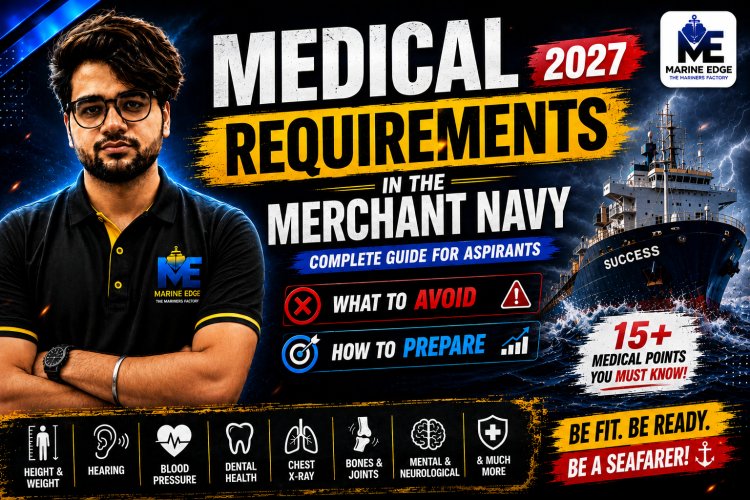
Medical Requirements for Merchant Navy 2027: Complete Medical Fitness Guide for Aspirants
A career in the Merchant Navy is one of the most attractive options for students who dream of travelling across the world, working on international vessels, gaining professional experience, and building a long-term maritime career. However, becoming a seafarer is not only about clearing an entrance examination or securing admission to a maritime institute. Medical fitness is one of the most important eligibility requirements for anyone planning to work at sea.
Students preparing for IMU-CET 2027, DNS, B.Sc. Nautical Science, B.Tech Marine Engineering, GME and other Merchant Navy pathways should understand the medical requirements well in advance. A candidate may have excellent academic marks and perform well in an entrance or sponsorship examination, but medical unfitness can still affect the candidate's ability to proceed towards sea service.
The medical standards exist because life onboard a ship requires physical strength, good hearing, adequate communication ability, coordination, mental stability, and the ability to respond effectively during emergencies. Unlike a shore-based job, a seafarer may work for extended periods away from immediate medical facilities. Therefore, medical fitness is directly connected with personal safety, crew safety and the safe operation of the vessel.
The medical requirements covered in the Marine Edge guide are based on fitness requirements for sea service and refer to standards governed by the Directorate General of Shipping (DG Shipping). The document also makes it clear that these requirements can change over time.
This detailed guide explains the major medical areas that Merchant Navy aspirants should understand before beginning their maritime career.
Why Medical Fitness Is Important in the Merchant Navy
Working on a ship requires much more than academic knowledge. A seafarer may have to work in machinery spaces, on decks, in engine rooms, accommodation areas, and other operational environments. Depending on the role, the job can involve climbing stairs and ladders, handling equipment, standing for long periods, working during changing weather conditions and responding to emergencies.
A medical condition that may have little effect on a normal classroom or office environment could become significantly more important onboard a vessel.
For example, good hearing is important because crew members need to communicate with one another and recognize alarms. Physical coordination is important when working around machinery or moving through different parts of a ship. Cardiovascular and respiratory fitness are important when performing physically demanding tasks. Mental and neurological fitness is also essential because maritime work involves responsibility, discipline, and safety-critical decision-making.
The Marine Edge medical guide states that candidates selected for sea service should be in good physical and mental condition and should not have health problems that prevent them from performing their duties effectively.
Therefore, medical fitness should not be treated as a last-minute formality. Aspirants should understand the requirements at the beginning of their preparation.
General Physical Fitness and Body Constitution
The first area of consideration is the candidate's overall physical constitution.
According to the supplied medical guide, the body should be well-formed and strong, without signs of weak musculature or serious physical abnormalities. The guide specifies a minimum height of 157 centimetres, approximately 5 feet 2 inches. It also states that weight should be appropriate for height and that the chest should be proportionate and capable of expanding by at least 5 centimetres.
This is important because students sometimes focus only on whether they meet a particular height requirement. However, medical fitness is broader than height alone. A candidate's general physical development and functional ability are also relevant.
Aspirants should therefore develop healthy habits early. Regular physical activity, appropriate nutrition, adequate sleep and maintaining a healthy lifestyle can help candidates improve their general fitness.
Candidates should also avoid extreme dieting or unhealthy attempts to change body weight immediately before a medical examination. The objective should be sustainable physical fitness rather than temporary changes made only to pass an examination.
Bones, Joints and Musculoskeletal Fitness
A seafarer's work may require climbing, walking, lifting, balancing and working in confined or technically demanding areas. Consequently, the condition of the bones, joints, spine, arms and legs is an important part of medical assessment.
The Marine Edge document states that candidates should not have diseases or problems involving the bones or joints that affect their normal functioning. Permanent tightness or bending of the chest or joints should not be present. The spine should be straight without unusual curvature, while the legs and feet should be normal.
The guide specifically mentions that knock knees may be acceptable if the candidate is able to walk and run. This demonstrates why candidates should not make assumptions based solely on the name of a physical condition. The actual medical assessment and functional ability matter.
Problems involving the arms or hands, significant deformities of the head, or damage resulting from fractures or skull injuries can also affect medical fitness.
Previous Fractures and Metal Implants
One point that aspirants should pay particular attention to is the history of fractures.
The supplied document states that if a broken bone has healed with a metal pin inside, the candidate will not be allowed to work at sea.
Students with a history of fractures should therefore obtain proper medical advice and understand how their specific condition is treated under the applicable maritime medical standards.
Ear, Nose and Throat Medical Requirements
Hearing is an essential part of maritime safety. On a ship, crew members must be able to communicate clearly and recognize sounds, warnings, and alarms.
The medical guide states that candidates should have good hearing and should not have conditions such as ear discharge, ear diseases, or unhealed holes in the eardrum. It also mentions serious ear infections, certain mastoid operations and congenital ear problems as medical concerns.
The guide states that a candidate should be able to hear a whisper from approximately 5 metres on both sides without using hearing aids.
It also specifies hearing-test requirements. Without hearing aids, the average hearing should be better than 40 decibels in both ears when tested at 500, 1000, 2000 and 3000 Hertz. Speech understanding without hearing aids should be at least 90% at 55 decibels in both ears.
Nose and Sinus Health
The nose and sinus system is also covered under ENT requirements.
According to the document, candidates should not have diseases involving the bones or soft tissues of the nose, nasal polyps, diseases of the nasal cavity, or sinus diseases.
Candidates experiencing persistent nasal or sinus problems should consult a qualified medical professional rather than relying on self-diagnosis.
Dental and Oral Health Requirements
Dental health is sometimes overlooked by Merchant Navy aspirants because students generally focus more on height, eyesight and hearing. However, oral health is also part of the medical assessment.
The medical guide states that candidates should not have lost or decayed teeth to such an extent that they cannot chew food properly.
The document also states that candidates should not have diseases affecting the throat, palate, tonsils or gums. Conditions or injuries that interfere with the normal functioning of the temporomandibular joint, which is the jaw joint, are also mentioned.
This is a good reason for aspirants to maintain regular dental hygiene and seek dental treatment for significant problems before undergoing the final medical assessment.
Speech and Communication Requirements
Communication is an essential professional skill at sea. Crew members need to communicate instructions clearly, particularly when performing operational duties or responding to emergency situations.
The Marine Edge medical guide states that candidates should not have speech problems that are too noticeable, including severe stammering or a very clear lisp involving difficulty making certain sounds.
Students who have concerns about their speech should consider getting professional advice well before the final medical examination.
It is important to distinguish between ordinary nervousness and a significant speech problem. The supplied document specifically refers to noticeable speech problems rather than suggesting that every minor speech variation automatically makes a candidate medically unfit.
Lymphatic and Glandular System
The medical assessment also includes the lymphatic and glandular system.
The document states that candidates should have a healthy glandular system, including the lymph nodes. There should not be signs of enlarged glands associated with tuberculosis or other diseases in the neck or other areas of the body.
This is another reason why a professional medical examination is important. Some medical findings cannot be accurately assessed by a candidate without appropriate clinical examination.
Heart and Cardiovascular Fitness
Cardiovascular health is particularly important for seafarers because the work environment can involve physical activity, long working hours, and emergency situations.
According to the supplied medical criteria, candidates should not have heart disease or problems involving blood vessels. The candidate's electrocardiogram (ECG) should be normal.
Blood Pressure
The medical guide states that blood pressure should not be higher than 140/90 mmHg. The systolic pressure should not exceed 140 and the diastolic pressure should not exceed 90.
Aspirants who have previously recorded high blood pressure should not panic or attempt to manipulate their readings before an examination. Instead, they should consult a qualified medical professional and follow appropriate medical advice.
Maintaining regular exercise, a balanced diet, adequate sleep and a healthy lifestyle can contribute to better cardiovascular health.
Respiratory System and Chest X-Ray
Breathing ability is another critical component of physical fitness for sea service.
The medical guide states that candidates should not have signs of chronic breathing problems, upper respiratory diseases or tuberculosis. It also states that candidates should not have a relevant history of these conditions.
The guide further specifies that the chest X-ray should appear normal.
Candidates with persistent breathing problems should consult a doctor well before the medical examination. Respiratory health should never be ignored, especially for candidates planning to work in demanding environments onboard ships.
Digestive System Requirements
The digestive system is also evaluated during the medical process.
According to the supplied medical guide, candidates should not have signs of disease affecting the digestive system. The liver and spleen should not be enlarged or easily felt during examination. The candidate should also not experience pain or tenderness when the abdomen is examined.
Maintaining a balanced diet and avoiding unhealthy eating patterns can support general digestive health.
Aspirants should also understand that medical fitness is not simply about appearance. A candidate may look physically fit but still have an underlying medical issue. That is why professional medical assessment is important.
Urinary System Requirements
The urinary system is another important area included in the medical examination.
The document states that the kidneys should not be swollen, diseased or easily felt by a doctor during examination. It also specifies that candidates will not be accepted if their urine contains:
-
Excess albumin or protein
-
Sugar
-
Red blood cells
These requirements are specifically stated in the supplied Marine Edge guide.
Candidates should therefore follow the instructions provided by the authorized medical examiner regarding urine testing and other investigations.
Hernia, Hydrocele and Related Conditions
The medical criteria also address several conditions involving the abdominal and reproductive areas.
The document states that candidates should not have a hernia or show signs of being likely to develop one. It also mentions hydrocele, varicocele, spermatocele, and other problems involving the private parts.
These are areas that candidates may sometimes feel uncomfortable discussing. However, they are legitimate medical considerations for a profession where physical fitness and occupational safety are important.
Candidates should be honest during their medical examination and seek qualified medical advice when they have concerns.
Rectal and Related Conditions
The supplied guide also specifies that candidates should not have fistulas, anal fissures, haemorrhoids or piles, or polyps in the rectum.
These conditions should be discussed confidentially with an appropriate medical professional.
If a candidate experiences symptoms, seeking medical attention early can be better than waiting until the final stage of recruitment or admission.
Sexually Transmitted Diseases and Related Medical Conditions
The medical guide states that candidates must not have active, hidden or inherited sexually transmitted diseases. It also states that candidates will not be accepted if the testicles have not descended properly and remain in the groin or abdomen.
These requirements highlight the importance of complete and honest medical evaluation.
Candidates should understand that the purpose of medical testing is to determine fitness for sea service, not to create unnecessary anxiety. Any medical concern should be discussed with a qualified doctor.
Skin Conditions and Scars
Skin conditions are another area considered during the medical examination.
The document states that candidates should not have skin diseases unless the condition is minor and temporary. It also states that very large scars or scars positioned in a way that could prevent the candidate from performing the job properly are not allowed.
This means candidates should not automatically assume that every scar will lead to medical rejection. The relevance of a scar can depend on its size, location and possible impact on occupational functioning.
Professional assessment is therefore more useful than assumptions based on information found online.
Brain and Nervous System
The nervous system plays a major role in concentration, coordination, movement, sensation and decision-making.
According to the supplied medical guide, candidates should not have a history or signs of mental illness, either personally or within the family history mentioned by the criteria.
The document also identifies several neurological and related concerns, including a history of seizures, urinary incontinence and bedwetting or enuresis.
Additional conditions mentioned include significant nervous or mental irritability, abnormal walking patterns, defective cranial nerve functions, lack of coordination and problems involving movement or sensation.
These requirements demonstrate why mental and neurological fitness should be treated as seriously as physical fitness.
Medical Fitness Is More Than Height and Eyesight
One of the most common misconceptions among Merchant Navy aspirants is that medical fitness means checking only height, weight, and eyesight.
In reality, the medical guide covers a much wider range of systems, including:
-
General physical constitution
-
Bones and joints
-
Spine and limbs
-
Ear and hearing
-
Nose and sinuses
-
Teeth and oral health
-
Speech
-
Lymphatic system
-
Heart and blood vessels
-
Blood pressure
-
Respiratory system
-
Digestive system
-
Urinary system
-
Reproductive health
-
Skin
-
Brain and nervous system
Therefore, candidates should think about medical fitness as a complete health assessment rather than a single test.
How to Prepare for Your Merchant Navy Medical Examination
Medical preparation should ideally begin months before the final examination.
1. Understand the Requirements Early
Read the applicable medical requirements before committing yourself to a maritime course. Understanding the standards early gives you time to identify possible concerns.
2. Get a Professional Medical Check-Up
If you have any doubts about your health, consult a qualified medical professional. Do not depend exclusively on online calculators or advice from friends.
3. Maintain Physical Fitness
Regular exercise can help improve general physical fitness. Activities such as walking, running, swimming or other suitable forms of exercise can support overall health.
4. Maintain Healthy Body Weight
The supplied guide states that weight should be appropriate for height. Avoid extreme diets and focus on sustainable healthy habits.
5. Look After Your Hearing
Avoid unnecessary exposure to extremely loud sounds and seek medical attention if you have persistent ear problems or hearing concerns.
6. Maintain Dental Hygiene
Brush regularly, maintain oral hygiene, and consult a dentist if you have significant tooth decay or other dental problems.
7. Monitor Blood Pressure
If you have a history of elevated blood pressure, seek medical advice rather than waiting until the final medical test.
8. Do Not Hide Medical History
Honesty during medical assessment is extremely important. Attempting to conceal a condition can create greater problems later.
9. Keep Medical Records
If you have undergone previous surgery, treatment, or fracture-related procedures, maintain relevant medical documentation. This can help the examining doctor understand your medical history.
10. Verify the Latest Standards
The Marine Edge document specifically notes that DG Shipping medical requirements can change over time.
Therefore, candidates should always verify the current requirements before their final examination.
Common Mistakes Merchant Navy Aspirants Make
Waiting Until the Last Moment
Many candidates think about medical fitness only after clearing an entrance examination or sponsorship test. This can be risky because identifying a concern at the last stage can create unnecessary stress.
Relying on Friends' Experiences
A medical decision should never be based solely on what happened to another candidate. Two candidates with apparently similar conditions may receive different medical assessments depending on the exact circumstances.
Ignoring Small Health Problems
Candidates sometimes ignore persistent dental, ENT, respiratory or other health concerns because the symptoms appear minor. Early medical evaluation is a better approach.
Trying to Manipulate Medical Results
Candidates should never attempt to artificially change blood pressure, conceal medical history or otherwise manipulate a medical examination.
Following Outdated Information
Maritime medical standards can change. The supplied Marine Edge document explicitly notes that DG Shipping rules may change over time.
Always use current and authorized information.
Marine Edge Point of View
At Marine Edge, we believe that preparation for a Merchant Navy career should begin long before the final admission stage.
Students preparing for IMU-CET, sponsorship examinations, and maritime institute admissions often focus heavily on academics. While academic preparation is essential, candidates should also understand whether they are medically prepared for sea service.
Medical fitness should not be viewed as an obstacle. It should be viewed as an early checkpoint that helps candidates understand the demands of their chosen profession.
A well-prepared aspirant should work on four areas simultaneously:
Academic Preparation + Entrance Examination Preparation + Sponsorship Preparation + Medical Fitness
When these areas are addressed together, candidates can approach the selection process with greater confidence and better awareness.
Marine Edge also encourages aspirants to seek professional medical advice whenever they have doubts about their fitness. The supplied medical guide is an educational resource, and candidates should verify the latest requirements with the appropriate authorities and authorized medical professionals before making final decisions.
Final Takeaway
A Merchant Navy career can provide exceptional professional opportunities, but it also demands a high level of responsibility and personal fitness.
Medical fitness is an essential part of becoming a seafarer because candidates must be capable of safely performing their duties in an environment that can be physically and mentally demanding.
The Marine Edge medical criteria cover a wide range of areas, including general physical constitution, bones and joints, hearing, ENT health, dental health, speech, cardiovascular health, respiratory health, digestive health, urinary and reproductive health, skin and neurological fitness.
The most important lesson for aspirants is simple: do not wait until the last stage to think about medical fitness.
If you are preparing for IMU-CET 2027, DNS, B.Sc. Nautical Science, B.Tech Marine Engineering or another Merchant Navy pathway, understand the applicable medical requirements early. Maintain a healthy lifestyle, consult qualified professionals when required, keep relevant medical records, and verify the latest DG Shipping standards before your official medical examination.
Your Merchant Navy journey does not begin when you step onboard your first vessel. It begins much earlier—with preparation, discipline, awareness, and the commitment to meet the professional standards required for life at sea.
Frequently Asked Questions
1. Is medical fitness compulsory for Merchant Navy candidates?
Yes. Candidates intending to work at sea need to meet applicable medical fitness standards. The supplied Marine Edge guide states that candidates must be physically and mentally fit for sea service.
2. What minimum height is mentioned in the medical guide?
The supplied document specifies a minimum height of 157 cm. It also states that weight should be appropriate for height and that chest expansion should be at least 5 cm.
3. Is hearing tested during the Merchant Navy medical examination?
Yes. The medical criteria include hearing requirements and specify standards involving whisper hearing, decibel levels, and speech understanding.
4. What blood pressure limit is mentioned?
The supplied guide states that blood pressure should not be higher than 140/90 mmHg.
5. Is a chest X-ray part of the medical requirements?
The guide states that the chest X-ray should appear normal and that candidates should not have chronic respiratory problems or tuberculosis.
6. Can dental problems affect medical fitness?
Yes. Significant tooth loss or decay that interferes with proper chewing is mentioned as a medical concern. Diseases affecting the gums, throat, palate, tonsils, or jaw function are also covered.
7. Can a previous fracture affect eligibility?
It can. The supplied document specifically states that a candidate with a healed fracture containing a metal pin will not be allowed to work at sea.
8. Are skin conditions considered during the medical examination?
Yes. The guide states that candidates should not have skin diseases except minor and temporary conditions. Large scars that interfere with job performance may also be unacceptable.
9. Are neurological and mental health requirements included?
Yes. The medical guide contains requirements relating to the brain and nervous system, including seizures, coordination, gait, cranial nerve functions, movement, and sensory problems.
10. Should I undergo a medical check-up before applying for a Merchant Navy course?
Getting an appropriate professional medical assessment early can help you understand your health status and identify potential concerns before you reach the final selection stage.
11. Can Merchant Navy medical requirements change?
Yes. The supplied guide states that the rules are set by DG Shipping and can change over time.
12. Is passing IMU-CET enough to join the Merchant Navy?
No. Clearing an entrance examination is only one part of the admission or selection process. Candidates must also satisfy the applicable eligibility, medical, and other requirements of their chosen course, institute, and recruitment pathway.
13. What should I do if I have a previous medical condition?
Do not make assumptions about your eligibility based on internet information or another candidate's experience. Consult an appropriate medical professional and verify the latest applicable maritime medical standards.
14. What is the best time to check medical fitness?
The best time is before investing significant time and money in the complete admission and sponsorship process. Early awareness allows candidates to seek appropriate professional advice and prepare accordingly.
Important Disclaimer
This article has been prepared from the medical requirements information supplied in the Marine Edge document. The document states that the relevant health rules are governed by DG Shipping and may change over time.
This article should therefore be treated as an educational guide and not as a substitute for an official medical examination. Candidates should confirm the latest applicable requirements and obtain their fitness assessment from the appropriate authorized medical professional before making final admission or career decisions.
About Marine Edge
Marine Edge – The Mariners Factory provides guidance and preparation support for students aspiring to build careers in the Merchant Navy. Its services and educational resources cover areas such as IMU-CET preparation, sponsorship examinations, interviews, psychometric assessments, medical awareness, and maritime career guidance.
The Marine Edge document also provides online learning support, study material, mock tests, and guidance for IMU-CET aspirants, including candidates preparing for IMU-CET 2027.
For an aspirant, the right approach is to prepare academically, professionally, and medically from the beginning. Prepare early, understand the requirements, and take your Merchant Navy career seriously.
Files
What's Your Reaction?