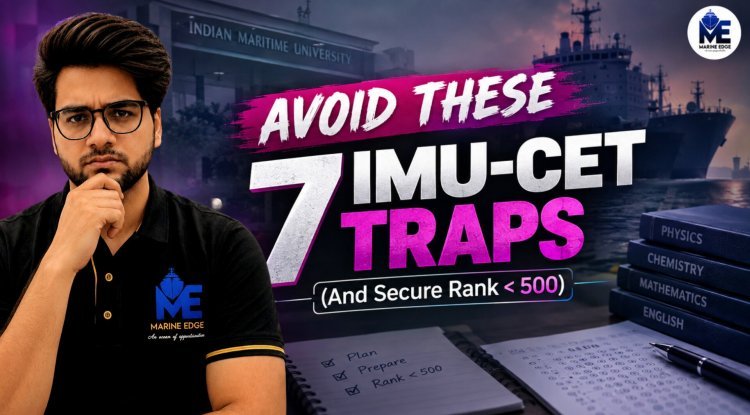
Is Taking a Drop Year Worth It for Merchant Navy Aspirants? Complete Guide After 12th (2026)
Confused about taking a drop year after Class 12 for the Merchant Navy? Learn the advantages, disadvantages, IMU-CET preparation strategy, sponsorship opportunities, eligibility, and expert guidance from Marine Edge to make the right career decision.

Is Taking a Drop Year Worth It for Merchant Navy Aspirants?
Every year, thousands of students dream of joining the Merchant Navy after completing Class 12. Many appear for IMU-CET, apply for sponsorship examinations, and prepare for interviews with leading shipping companies. While some secure admission on their first attempt, many talented students narrowly miss the required IMU-CET rank or fail to obtain sponsorship due to insufficient preparation, interview performance, or medical fitness.
This often leads to one important question:
"Should I take a drop year for the Merchant Navy?"
The answer isn't the same for everyone.
For some students, a well-planned drop year becomes the turning point that helps them secure admission into top maritime institutes and sponsorship from reputed shipping companies. For others, taking a gap year without proper planning can simply delay their career without improving their chances.
At Marine Edge, we have mentored thousands of Merchant Navy aspirants over the years. Based on our experience, we have seen students transform their careers by using their drop year wisely through structured preparation, regular mock tests, sponsorship interview training, personality development, and medical guidance.
In this comprehensive guide, we'll help you understand whether taking a drop year is the right decision for you, along with practical strategies to maximize your chances of success.
Why Do Students Think About Taking a Drop Year?
A drop year is not always the result of failure. In many cases, it is a strategic decision taken by students who want to improve their overall profile before reappearing for IMU-CET or sponsorship examinations.
Some of the most common reasons include:
- Low IMU-CET Rank
- Failure to secure sponsorship
- Lack of preparation during Class 12
- Poor performance in interviews
- Weak English communication skills
- Medical or fitness issues
- Lack of awareness about the admission process
- Missing application deadlines
Many students realize after their first attempt that succeeding in the Merchant Navy requires much more than simply clearing IMU-CET. Sponsorship exams, psychometric tests, medical examinations, communication skills, and interview performance all play an equally important role.
A drop year allows aspirants to strengthen these areas and become better prepared for the next admission cycle.
Understanding the Merchant Navy Admission Process
Before deciding whether a drop year is worth it, it is important to understand how Merchant Navy admissions actually work.
Unlike many other professional courses, admission into the Merchant Navy involves multiple stages, each evaluating different aspects of a student's capability.
Step 1: Qualify IMU-CET
The Indian Maritime University Common Entrance Test (IMU-CET) is the first and most important step for admission into various maritime courses, including:
- DNS (Diploma in Nautical Science)
- B.Sc. Nautical Science
- B.Tech Marine Engineering
- B.Tech Naval Architecture
- Other IMU-affiliated maritime programmes
The examination tests a student's understanding of:
- Physics
- Chemistry
- Mathematics
- English
- Aptitude & Reasoning
- General Knowledge
A better IMU-CET rank significantly improves the chances of securing admission into reputed maritime institutes.
Step 2: Sponsorship Examination
Many leading shipping companies conduct their own sponsorship examinations before admitting candidates into pre-sea training.
These examinations generally include:
- Written Test
- Aptitude Assessment
- Psychometric Evaluation
- English Communication
- Technical Interview
- HR Interview
Clearing sponsorship ensures that students receive onboard training after completing their academic programme, making it one of the most important stages of the admission process.
Step 3: Medical Examination
Merchant Navy medical standards are among the strictest in any profession.
Candidates are evaluated for:
- Vision standards
- Colour blindness
- Hearing ability
- BMI
- Physical fitness
- General health
- Medical history
Many students overlook this stage until the last moment, resulting in unexpected disqualification despite clearing IMU-CET and sponsorship interviews.
Step 4: Admission into Maritime Institute
Once students successfully complete all required stages, they receive admission into IMU-affiliated colleges or company-sponsored maritime institutes.
The quality of the institute and sponsorship company often determines future onboard training opportunities, exposure, and career progression.
Why IMU-CET Alone Doesn't Guarantee Success
One of the biggest misconceptions among students is that scoring well in IMU-CET guarantees admission into the Merchant Navy.
In reality, shipping companies evaluate much more than academic performance.
Most sponsorship interviews focus on:
- Personality
- Confidence
- Communication Skills
- Leadership Qualities
- General Awareness
- Discipline
- Professional Attitude
- Decision Making
- Motivation to Join the Merchant Navy
Students who prepare only for IMU-CET often struggle during sponsorship interviews.
This is why comprehensive preparation—including academics, interview skills, personality development, and physical fitness—is essential.
Is Taking a Drop Year Worth It?
The simple answer is:
Yes—but only if you use it wisely.
A drop year should never be viewed as a year lost. Instead, it should be treated as an investment in building a stronger foundation for a successful maritime career.
If used effectively, a drop year can help you:
- Improve your IMU-CET rank
- Secure sponsorship from reputed shipping companies
- Develop strong communication skills
- Build confidence for interviews
- Improve physical fitness
- Meet medical standards comfortably
- Increase awareness of the maritime industry
- Gain better career opportunities
However, taking a drop year without discipline, guidance, or a proper study plan often leads to repeating the same mistakes.
The difference between a successful drop year and a wasted one lies in structured preparation.
Top Benefits of Taking a Drop Year for Merchant Navy Aspirants
Taking a drop year after Class 12 is often viewed negatively because students feel they are "losing" one academic year. However, in the Merchant Navy, success is not determined solely by academic marks. Admission depends on your overall preparation, including IMU-CET performance, sponsorship selection, communication skills, medical fitness, and personality.
A well-planned drop year can provide enough time to improve in all these areas and significantly increase your chances of joining a reputed maritime institute and shipping company.
Let's explore the major advantages in detail.
1. Improve Your IMU-CET Rank Significantly
The IMU-CET is one of the most competitive entrance examinations for Merchant Navy aspirants. Every mark matters because a better rank opens the doors to better colleges, preferred courses, and higher sponsorship opportunities.
Many students appear for IMU-CET while balancing Class 12 board examinations. Because of this, they often fail to give enough time to entrance preparation.
A drop year allows students to focus entirely on IMU-CET without the pressure of school examinations.
During this period, students can:
- Revise the complete syllabus multiple times
- Strengthen weak concepts in Physics, Chemistry, and Mathematics
- Improve speed and accuracy
- Practice previous year papers
- Attempt full-length mock examinations
- Learn effective time-management techniques
Even a moderate improvement in rank can completely change your admission opportunities.
Marine Edge Guidance
At Marine Edge, we encourage students to focus on concept-based learning rather than rote memorization. Through structured classroom sessions, daily practice tests, and All India mock examinations, students develop the confidence needed to perform well under real exam conditions.
Consistent practice over several months often results in substantial improvements in IMU-CET rankings.
2. Better Chances of Securing Sponsorship
Many students believe that clearing IMU-CET guarantees a Merchant Navy career.
In reality, obtaining sponsorship from a reputed shipping company is equally important.
Top shipping companies carefully evaluate candidates before offering sponsorship.
Their selection process generally includes:
- Written Examination
- Psychometric Assessment
- Aptitude Test
- Personal Interview
- HR Round
- Medical Examination
Students who prepare only for IMU-CET often struggle during sponsorship interviews because they have never been trained for these additional stages.
A drop year provides enough time to prepare specifically for sponsorship examinations.
What Shipping Companies Look For
During sponsorship interviews, companies assess much more than academic knowledge.
Interview panels usually evaluate:
- Communication skills
- Confidence
- Professional attitude
- Leadership qualities
- Discipline
- General awareness
- Knowledge about the Merchant Navy
- Decision-making ability
- Problem-solving skills
- Long-term career goals
Developing these qualities requires consistent practice over several months.
Marine Edge Guidance
Marine Edge offers dedicated sponsorship preparation modules that simulate actual company selection procedures. Students participate in mock interviews, group discussions, psychometric assessments, and HR interaction sessions designed according to current industry standards.
This practical exposure helps students become familiar with interview environments and significantly boosts their confidence.
3. Build Strong Communication Skills
One of the biggest reasons students fail sponsorship interviews is poor communication.
Many aspirants come from regional language backgrounds and have limited experience speaking English confidently.
While technical knowledge is important, shipping companies also expect cadets to communicate effectively with multinational crews onboard ships.
During a drop year, students can dedicate time to improving:
- Spoken English
- Vocabulary
- Pronunciation
- Listening skills
- Public speaking
- Interview communication
- Group discussion performance
- Self-introduction
These improvements not only help during sponsorship interviews but also prepare students for life onboard international vessels.
Why Communication Matters at Sea
Merchant Navy officers regularly communicate with:
- Captains
- Chief Engineers
- International crew members
- Port authorities
- Pilots
- Surveyors
- Coast Guards
- Shipping company officials
Effective communication directly contributes to operational safety and professional growth.
4. Prepare for Psychometric Tests
Many sponsorship examinations now include psychometric assessments.
These tests evaluate a candidate's personality, behaviour, emotional stability, and suitability for working in challenging maritime environments.
Common areas assessed include:
- Leadership
- Teamwork
- Emotional control
- Decision making
- Stress management
- Adaptability
- Responsibility
- Integrity
Students who have never attempted psychometric tests often find them confusing.
A drop year allows sufficient time to understand the test format and practice different types of assessments.
Marine Edge Guidance
Our psychometric training sessions help students understand how shipping companies evaluate behavioural traits. Rather than teaching students to "memorize answers," we focus on helping them develop the professional qualities expected in the maritime industry.
5. Improve Physical Fitness Before Medical Examination
Medical fitness is one of the most important stages of Merchant Navy selection.
Unfortunately, many students ignore their health until they receive a sponsorship offer.
This often creates unnecessary stress.
A drop year gives candidates enough time to work on:
- Body weight
- BMI
- Stamina
- Endurance
- General fitness
- Lifestyle improvements
Students who require medical guidance or fitness improvement can address these issues gradually instead of rushing at the last moment.
Merchant Navy Medical Standards
Medical examinations generally assess:
- Eyesight
- Colour vision
- Hearing ability
- Blood pressure
- Height and weight
- BMI
- General health
- Medical history
- Physical fitness
Preparing early helps avoid unexpected surprises during the final selection stage.
6. Gain Better Industry Awareness
Interview panels frequently ask questions related to the Merchant Navy industry.
Examples include:
- Types of ships
- Rank hierarchy
- Shipping companies
- Navigation
- Engine department
- Life onboard
- International trade
- Maritime regulations
- Ports
- Career progression
Students who genuinely understand the industry perform much better than those who simply memorize interview questions.
A drop year provides enough time to develop this awareness through continuous learning.
Marine Edge Guidance
Marine Edge regularly conducts industry awareness sessions where students learn about real-life ship operations, maritime careers, shipping companies, onboard responsibilities, and career growth opportunities.
This practical knowledge greatly improves interview performance.
7. Develop a Professional Personality
Merchant Navy officers represent both their shipping company and their country.
Professionalism begins long before joining a ship.
Students can use a drop year to improve:
- Grooming
- Discipline
- Time management
- Leadership
- Confidence
- Professional etiquette
- Body language
- Positive attitude
These qualities create a strong impression during interviews and remain valuable throughout a maritime career.
8. Learn from Previous Mistakes
One of the biggest advantages of taking a drop year is the opportunity to analyse your previous attempt honestly.
Ask yourself:
- Which subjects were weak?
- Did I practice enough mock tests?
- Was my English communication poor?
- Did I fail the sponsorship interview?
- Was I physically unfit?
- Did I apply too late?
- Was I nervous during interviews?
Identifying these shortcomings helps students avoid repeating the same mistakes.
Marine Edge Guidance
Rather than starting preparation from scratch, our mentors first analyse each student's previous performance. This personalized approach helps create a focused improvement plan based on individual strengths and weaknesses.
9. Access More Sponsorship Opportunities
Many shipping companies release sponsorship applications at different times throughout the year.
Well-prepared students can apply to multiple companies instead of relying on a single opportunity.
This increases the probability of selection.
Popular sponsorship opportunities include:
- Anglo-Eastern
- Great Eastern Shipping
- Synergy Marine Group
- Fleet Management
- MSC
- V.Group
- Scorpio Marine
- MOL
- Chevron
- Executive Ship Management
Applying strategically to multiple companies greatly improves the chances of securing sponsorship.
10. A Better Start Can Lead to a Better Career
A Merchant Navy career typically spans more than two decades.
Although taking a drop year delays entry by a few months or a year, it can result in:
- Better IMU-CET rank
- Better maritime institute
- Better sponsorship company
- Better onboard training
- Higher exposure
- Stronger career foundation
- Faster confidence during cadetship
Looking at the long-term career, one year of focused preparation can become a worthwhile investment if it leads to better opportunities.
Marine Edge Perspective
At Marine Edge, we believe that a drop year should never be viewed as a "gap" but as a preparation year. Students who follow a disciplined schedule, practice consistently, and prepare for every stage of the Merchant Navy selection process often enter the industry with greater confidence and a stronger foundation.
The goal is not simply to clear IMU-CET but to become a well-rounded candidate who is academically strong, physically fit, professionally confident, and fully prepared for sponsorship interviews and life at sea.
Key Takeaways
| Advantage | How It Helps |
|---|---|
| Better IMU-CET Rank | Increases admission opportunities |
| Sponsorship Preparation | Improves selection chances |
| Communication Skills | Builds confidence for interviews |
| Psychometric Practice | Prepares for company assessments |
| Medical Fitness | Helps meet health standards |
| Industry Knowledge | Improves interview performance |
| Personality Development | Creates a professional impression |
| Learning from Mistakes | Avoids repeating previous errors |
| Multiple Sponsorship Applications | Increases chances of selection |
| Strong Career Foundation | Supports long-term professional growth |
Frequently Asked Questions (FAQs)
1. Is taking a drop year a good decision for Merchant Navy aspirants?
A drop year can be a good decision if it is used productively. Students who utilize this time to improve their IMU-CET preparation, communication skills, sponsorship interview performance, and medical fitness often increase their chances of securing admission and sponsorship. However, taking a drop year without a structured study plan may not provide the desired results.
2. Will taking a drop year affect my Merchant Navy career?
No. Shipping companies generally focus on your current knowledge, confidence, communication skills, and overall readiness rather than whether you took a drop year. If you use the extra time to improve your profile, a drop year can actually strengthen your career prospects 3. Can I improve my IMU-CET rank after taking a drop year?
Yes. A dedicated preparation year allows students to revise the syllabus thoroughly, practice mock tests, solve previous years' papers, and strengthen weak subjects. This often leads to a significantly better IMU-CET rank.
4. Is IMU-CET the only requirement for joining the Merchant Navy?
No. IMU-CET is only one stage of the admission process. Most students also need to clear sponsorship examinations, psychometric tests, personal interviews, and medical examinations conducted by shipping companies before joining a maritime institute
5. Why do many students fail to secure sponsorship despite clearing IMU-CET?
Many students focus only on academics and neglect communication skills, personality development, interview preparation, and industry awareness. Sponsorship selection evaluates both technical knowledge and professional qualities.
6. What should I do during a drop year to improve my selection chances?
A productive drop year should include regular IMU-CET preparation, sponsorship interview practice, English communication improvement, mock tests, psychometric training, physical fitness, medical readiness, and learning about the Merchant Navy industry.
7. How important are communication skills in Merchant Navy sponsorship interviews?
Communication skills are extremely important. Shipping companies prefer candidates who can communicate confidently with multinational crews, officers, and port authorities. Strong English speaking skills often create a positive impression during interviews.
8. Can a drop year help improve my sponsorship interview performance?
Yes. During a drop year, students have enough time to participate in mock interviews, group discussions, personality development sessions, and HR interview practice. These activities help build confidence and improve overall interview performance.
9. Should I focus only on IMU-CET preparation during my drop year?
No. A balanced preparation strategy is essential. Along with academics, students should also prepare for sponsorship tests, psychometric assessments, medical examinations, and personality development to maximize their chances of selection.
10. Is physical fitness important for Merchant Navy admissions?
Yes. Every candidate must meet the medical standards prescribed for Merchant Navy courses. Maintaining a healthy BMI, good eyesight (as per eligibility), hearing ability, and overall fitness is crucial for final selection.
11. Can I apply for sponsorship in multiple shipping companies?
Yes. Eligible candidates can apply to multiple shipping companies, provided they meet the respective eligibility criteria. Applying to several reputed companies increases the chances of securing sponsorship. 12. What are the biggest advantages of taking a drop year?
The major advantages include improving your IMU-CET rank, enhancing sponsorship interview skills, developing better communication, increasing industry awareness, improving medical fitness, and building a stronger overall profile for Merchant Navy selection.
13. How can Marine Edge help students during a drop year?
Marine Edge provides comprehensive guidance for IMU-CET preparation, sponsorship examinations, mock interviews, psychometric assessments, personality development, communication training, and medical guidance. A structured preparation plan helps students prepare for every stage of the Merchant Navy selection process.
14. Is one year of preparation worth it for a long-term Merchant Navy career?
If the extra year helps you secure admission into a better institute or sponsorship from a reputed shipping company, it can be a valuable investment. A strong start often leads to better career opportunities and long-term professional growth.
15. What is the biggest mistake students make during a drop year?
The most common mistake is preparing without a proper strategy. Students who study inconsistently or focus only on IMU-CET often miss out on sponsorship preparation, communication skills, and personality development. A disciplined and structured approach is essential for making the most of a drop year.
Marine Edge Guidance
At Marine Edge, we have observed that students who dedicate a drop year to structured IMU-CET preparation, sponsorship training, interview practice, and physical fitness significantly improve their chances of selection compared to students who rely only on self-study.
A well-planned drop year is not about studying longer—it's about studying smarter, identifying weaknesses, and preparing for every stage of the Merchant Navy selection process.
Our experience shows that students who combine consistent academic preparation with mock interviews, psychometric training, communication development, and medical guidance are far better equipped to secure admission into top maritime institutes and sponsorship programmes.
What's Your Reaction?